

Why U.S. Importers Should Partner with TrianglePM to Recover IEEPA Tariffs: Post-Supreme Court Guide

The Supreme Court Ruling: What Changed
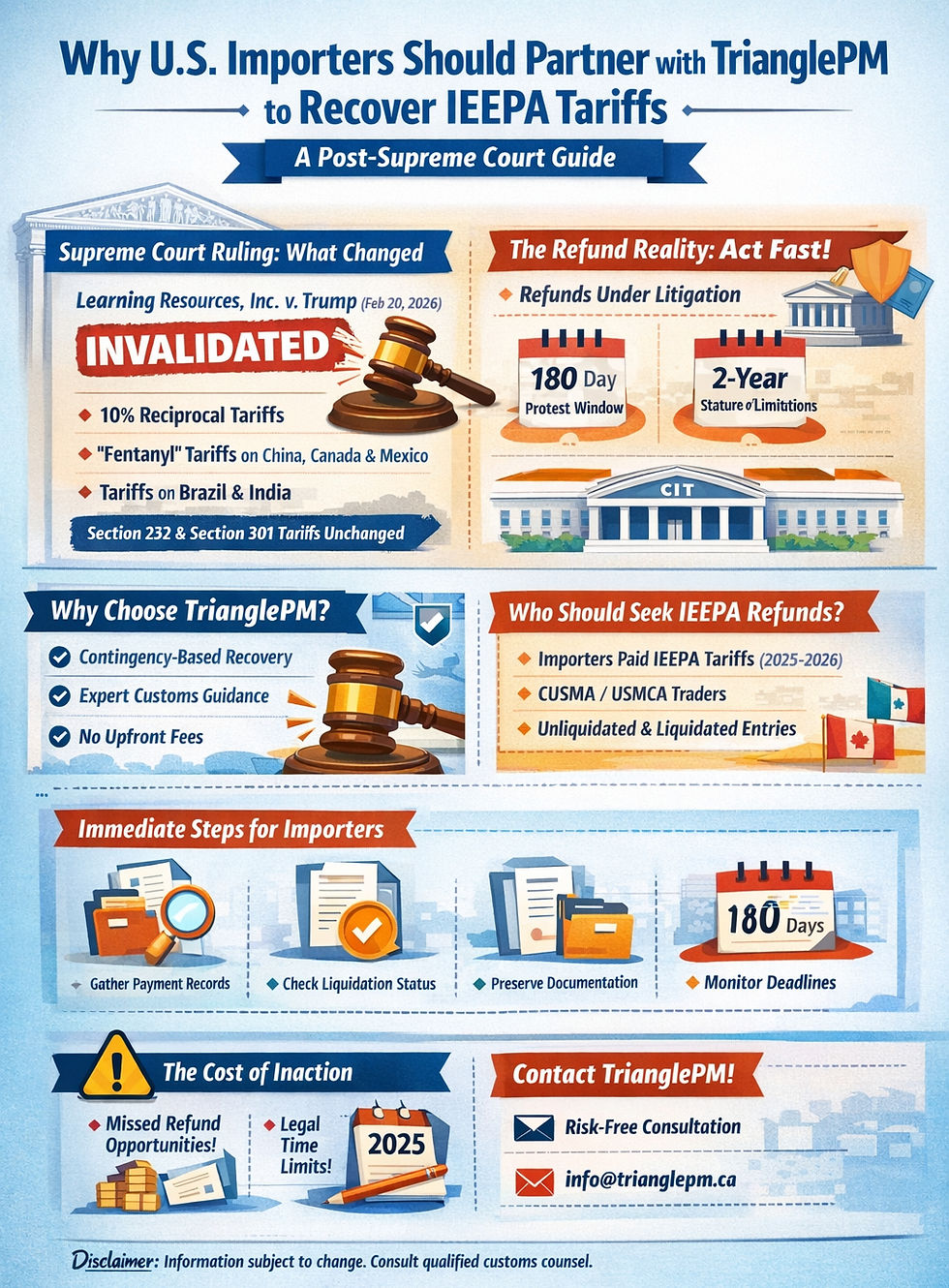
On February 20, 2026, the U.S. Supreme Court issued a landmark 6-3 decision in Learning Resources, Inc. v. Trump, holding that the International Emergency Economic Powers Act (IEEPA, 50 U.S.C. § 1701) does not authorize the President to impose tariffs . The Court emphasized that the Constitution assigns taxing authority to Congress, and IEEPA's provision allowing the President to "regulate" importation does not clearly encompass the power to levy tariffs .
This ruling invalidated IEEPA tariffs imposed between February 4, 2025, and February 24, 2026, including:
Reciprocal tariffs (10% or higher on most trading partners)
"Fentanyl" tariffs on China, Canada, and Mexico
Additional tariffs on Brazil and India
Critical distinction: The ruling does not affect Section 232 (steel, aluminum, auto) or Section 301 (China-related) tariffs, which remain valid under separate statutory authorities .
The Refund Reality: Why Importers Must Act Now
The Supreme Court did not establish a refund mechanism—this remains under litigation in the Court of International Trade (CIT) . However, legal precedent suggests that tariffs collected under an invalidated authority constitute illegal exactions that the government may not retain.
On March 4, 2026, the CIT ordered CBP to liquidate unliquidated entries without IEEPA duties and reliquidate certain liquidated entries . CBP is developing an automated system (CAPE) to process refunds, but as of March 2026, this system remains incomplete.
The deadline risk: Importers face potential procedural barriers. While the CIT has suggested that direct lawsuits may not require prior CBP protests for IEEPA challenges , the standard 180-day protest window applies to liquidated entries, and a two-year statute of limitations may apply to CIT actions under 28 U.S.C. § 1581(i) . Importers who delay may forfeit recovery rights.
Why Partner with TrianglePM To Recover IEEPA Tariffs?
Navigating IEEPA Tax Recovery and refund eligibility requires deep expertise in customs law, CBP procedures, and rapidly evolving litigation. TrianglePM provides a comprehensive, end-to-end solution designed to simplify the process and maximize successful outcomes:
Full-service support to recover IEEPA tariffs: From initial eligibility assessment to complete claim preparation and submission
No upfront fees: Our model is entirely success-based, ensuring zero financial risk to importers
Contingency pricing: A 15–25% success fee applies only after CBP approves and processes your refund
Customs and compliance expertise: We handle all documentation, ACE portal requirements, and direct communication with CBP
With over 2,000 lawsuits filed in the CIT and CBP’s refund system still evolving, importers gain a strategic advantage by partnering with experts who can position claims efficiently and improve the likelihood of timely recovery.
Who Should Consider IEEPA Recovery?
U.S. importers who paid IEEPA tariffs between February 2025 and February 2026
Canadian and Mexican businesses shipping under CUSMA/USMCA affected by IEEPA duties
Companies with unliquidated entries or recently liquidated shipments
Businesses that lack internal customs expertise to manage complex refund claims
Note: Eligibility depends on specific import history, entry liquidation status, and current CBP regulations. TrianglePM conducts individualized assessments to determine potential recovery.
Immediate Steps for Importers:
Compile IEEPA payment records: Extract entry data from CBP's ACE portal, including entry numbers, dates, HTS classifications, and duty amounts
Determine liquidation status: Unliquidated entries may process differently than liquidated ones requiring protests or CIT action
Preserve documentation: Maintain entry summaries, commercial invoices, proof of payment, and broker communications
Monitor deadlines: Be aware of potential 180-day protest windows and two-year CIT filing limitations
The Cost of Inaction
Justice Kavanaugh's dissent noted that refunding IEEPA tariffs "is likely to be a 'mess'" . CBP has indicated its existing systems are "not well-suited" for the unprecedented volume of refunds . Importers who fail to preserve their rights—whether through timely protests, CIT filings, or CAPE system registration—risk missing recovery opportunities as procedural complexities mount.
Conclusion
In the wake of the Supreme Court’s decision in Learning Resources, Inc. v. Trump, U.S. importers are presented with a rare but time-sensitive opportunity to recover unlawfully collected duties. However, the path to securing these refunds is anything but straightforward—marked by evolving legal interpretations, procedural deadlines, and an underdeveloped CBP refund system. This is where IEEPA Tax Recovery becomes both urgent and complex. By partnering with TrianglePM, importers gain a strategic advantage through expert-led guidance, contingency-based pricing, and end-to-end claim management designed to maximize recovery while minimizing risk. As deadlines approach and administrative challenges intensify, taking informed action today is critical to protecting your financial interests and ensuring no eligible refund is left unclaimed.


Comments